
THE WORLD OF THE STAGE I
Yuan Gong Solo Exhibition at San Servolo, Venice
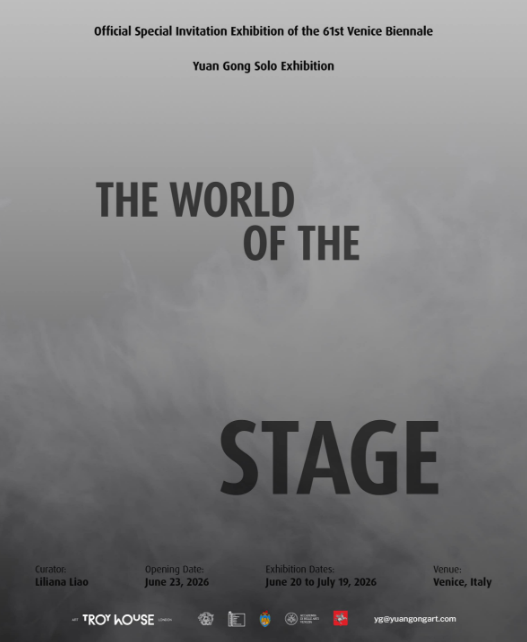
Exhibition Information
The World of the Stage I
Yuan Gong Solo Exhibition
Curated by Liliana Liao
Academic Chair: Professor Saverio Simi de Burgis, Accademia di Belle Arti di Venezia Historic Asylum Complex, San Servolo, Venice, Italy
Opening: 23 June 2026
Exhibition dates: 24 June–19 July 2026
Venice, Italy —23 June 2026—The World of the Stage I, a solo exhibition by Yuan Gong, curated by Liliana Liao and with Professor Saverio Simi de Burgis of the Accademia di Belle Arti di Venezia serving as Academic Chair, opens at the Historic Asylum Complex on San Servolo, Venice. On view from 24 June to 19 July 2026, the exhibition inaugurates the first chapter of The World of the Stage, a long-term curatorial and performative project that will continue through future editions in different cities, sites, and social contexts.
For Yuan Gong, the “stage” is not limited to theatre. It is a condition of contemporary life through which bodies, institutions, architecture, media, and social relations construct and negotiate meaning. For two decades, Yuan Gong has worked across performance, installation, video, urban intervention, and participatory action. Performance remains central to his practice, while video, photography, and archival documents allow actions to extend beyond their immediate moment, circulation, and reception.
The World of the Stage Iunfolds across two sites on San Servolo, Venice’s former asylum island. It brings a newly realised performance into dialogue with works from Yuan Gong’s long-term practice, examining identity, authorship, visibility, control, and spectatorship.
On 22 June 2026, The Birth of the Jesterwas performed inside the Museo del Manicomio, San Servolo, constituting the project’s first live site. The performance initiates a long-duration work that will continue in other cities and contexts. Yuan Gong’s face becomes an open interface: participants apply makeup, redraw his features, and collectively produce the image of a jester. The artist deliberately relinquishes authority over the final form. Identity emerges not as a fixed self, but as a contingent and shared process.
On 23 June, The Birth of the Jestercontinues in the San Servolo exhibition space, forming the work’s second live site. The two situations are not repetitions of one another. Situated within different spatial structures, audiences, and modes of viewing, they allow the same action to generate distinct social meanings and relations. The jester is neither a costume nor a predetermined character. It is a liminal figure—unstable, plural, and unfinished—shaped by power, culture, vulnerability, and affect. Each application of makeup is both an individual gesture and a projection of wider social structures. A face remade in public exposes shifting boundaries between selfhood and social definition, observation and participation, care and control.
Also opening on 23 June, the exhibition presents documentation, photographs, archival materials, and selectedmoving-image works from nearly thirty performance projects made over the past twenty years. Rather than functioning as a conventional retrospective, it traces an interconnected research methodology—an archaeology of the conditions that make representationpossible. Borders become sites of negotiation; ruins become spaces of renewed ritual; atmosphere becomes an immaterial medium; repetition produces and undoes meaning; and absence enables action to persist beyond the artist’s physical presence.
Featured works include Soft Sculpture –Backstage(2024), in which the body becomes a pliable, puppet-like apparatus directed by visible and invisible forces; Stroll(2012), which uses scent and mist to turn public movement into an unsettled sensory encounter; Air Strike Around the World(2013), a network-synchronised intervention using remote-controlled aerial devices to release fragrant vapour in Shanghai and Venice; and China Scale(2008), which transforms spatial compression, repeated gas discharge, and the numerical unit “314” into measures of psychological pressure and institutional tension.
Across these works, Yuan Gong shifts attention from the autonomous art object to the situation itself. Atmosphere, smell, expectation, tension, involuntary participation, and mediated memory become artistic materials. His work does not portray systems of power from a distance; it stages their effects on bodies, perception, and public behaviour. Space is never merely a backdrop: it shapes conduct, distributes visibility, and determines the terms of encounter.
The World of the Stage Iis both an exhibition and an opening. Venice establishes the first instalment of a project designed to reactivate itself across locations and editions. Each future chapter will generate another configuration of the stage through changed settings, publics, and relations. The viewer is not external to this process, but part of it: observer, participant, and a component of the structure being examined.